
Duty of care: documenting national protected lands at-risk in the United States
By Heather Bourbeau
For the last 10 months, I have been traveling through nine Western states in the United States, documenting national lands at risk. I have seen desert monuments, ancient forests, and pristine river systems. All are threatened by the actions and efforts of President Trump and his administration.
One of the lands I chose to document was the Mt. Baker-Snoqualmie National Forest, home to more glaciers than any other U.S. national forest outside of Alaska. At the ranger station, I meet a multi-generational lumberman who has a small tree farm and talks of the destructive nature of industrial logging, the need to consider the whole ecosystem in restoration, starting with and including plankton. He quickly touches my sun shirt, says, “Microplastics are destroying plankton.” He directs me to hike the Harold Engles Memorial Grove and the North Fork Sauk River.
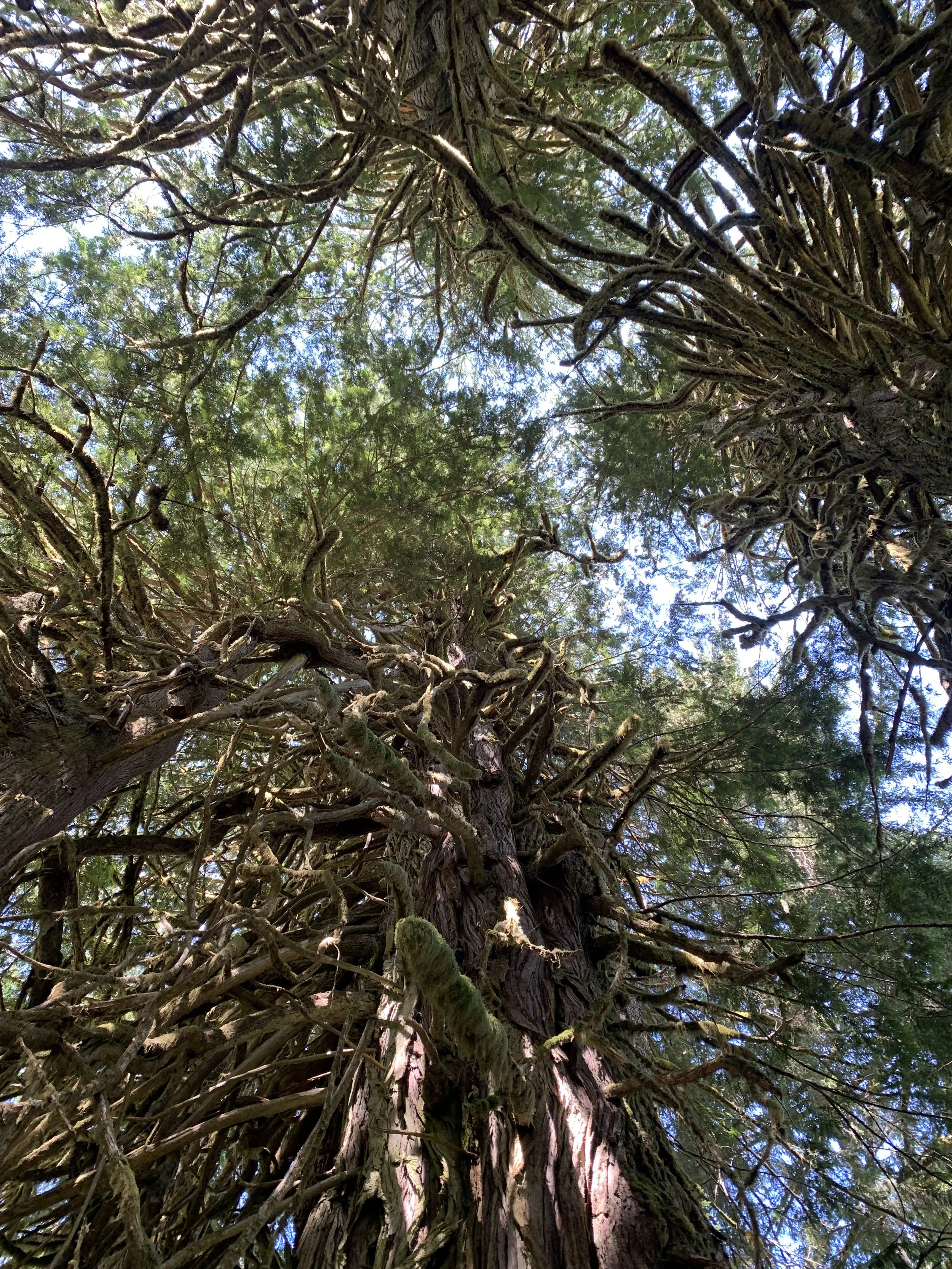
Upon entering the grove, I find my blood pressure drops, my mind settles into the present moment for the first time in days, and I find an unusual comfort in the soft, mossy, thick understory of these old-growth red and yellow cedars. For a while, I hear only the river ahead of me, then a Pacific wren. I could stay here in suspended beauty for days. I take photos and field recordings, write notes that will become poetry, and stand among these giants—aware of all that soon might be lost.
On his first day back in office, Trump signed the National Energy Emergency Executive Order and the Unleashing American Energy Executive Order, which direct agencies to expedite the development of fossil fuels on federal lands. Soon after, he signed the Executive Order on the Immediate Expansion of American Timber Production and has pushed other efforts to privatize and exploit public land, threatening ecosystems, public health, and cultural and religious sites.
At Mt. Baker-Snoqualmie National Forest, those glaciers are at risk of retreating. Between 1971 and 1998, the number of glaciers decreased from 295 to 287, and between 1984 and 2006, forest glaciers lost 20-40 percent of their volume. This has resulted in significantly lower summer glacier runoff, reducing streamflow and increasing water temperatures, which adversely affects species such as salmon.
When forests are cleared, the carbon dioxide they have absorbed is released, contributing to increased atmospheric carbon dioxide levels and intensifying the global warming effects of climate change. This leads to higher temperatures, melting glaciers, rising sea levels, and more extreme weather events.
While the Mount Baker–Snoqualmie National Forest contains several areas that are wilderness designations, providing permanent protection to old-growth forest areas (42 percent of the forest’s current area), heavy tree cutting in other areas of the forest and private lands nearby have raised the risk of more glacier retreat, making everyone, not just locals, significantly more vulnerable.
For instance, on March 22, 2014, in the nearby town of Oso, Washington, a landslide engulfed an area approximately 2.5 square kilometers, leading to 43 deaths and 49 homes destroyed. It is one of the deadliest landslides in U.S. history. Survivors and families of those who died sued the Washington State Department of Natural Resources, asserting that lax logging regulations in a groundwater-recharge zone above the slope were one of the factors that led to the slide.
On June 23, 2025, Secretary of Agriculture Brooke Rollins announced her intention to rescind the Roadless Rule. She justified this decision saying this will “remove prohibitions on road construction, reconstruction, and timber harvest … allowing for fire prevention and responsible timber production.” Never mind that roads increase forest vulnerability to wildfires and landslides.
The rescission will impact over 45 million acres in national forests across the country, including 336,000 acres in Mt. Baker-Snoqualmie. Washington State Governor Bob Ferguson and Attorney General Nick Brown have argued that new road development would “increase the risk of wildfire, pollute our waters, threaten and destroy wildlife habitat,” and impact drinking water for Seattle and Tacoma, which rely on watersheds fed mainly by snowmelt from the Mount Baker-Snoqualmie National Forest.
The U.S. Department of Agriculture hopes to finalize a rewrite of the rescission by the end of 2026.
For now, I will continue to document, to raise awareness of the current threats, and to savor the spectacular generosity of these lands.
My dream project is to create an interactive map of the lands discussed in my At-Risk:Protected project, so that when people click on a land, they can experience that national forest, monument, or preserve through my visual and audio recordings, essays, and spoken poems, as well as learn actions they can take to protect that land.
Heather Bourbeau